
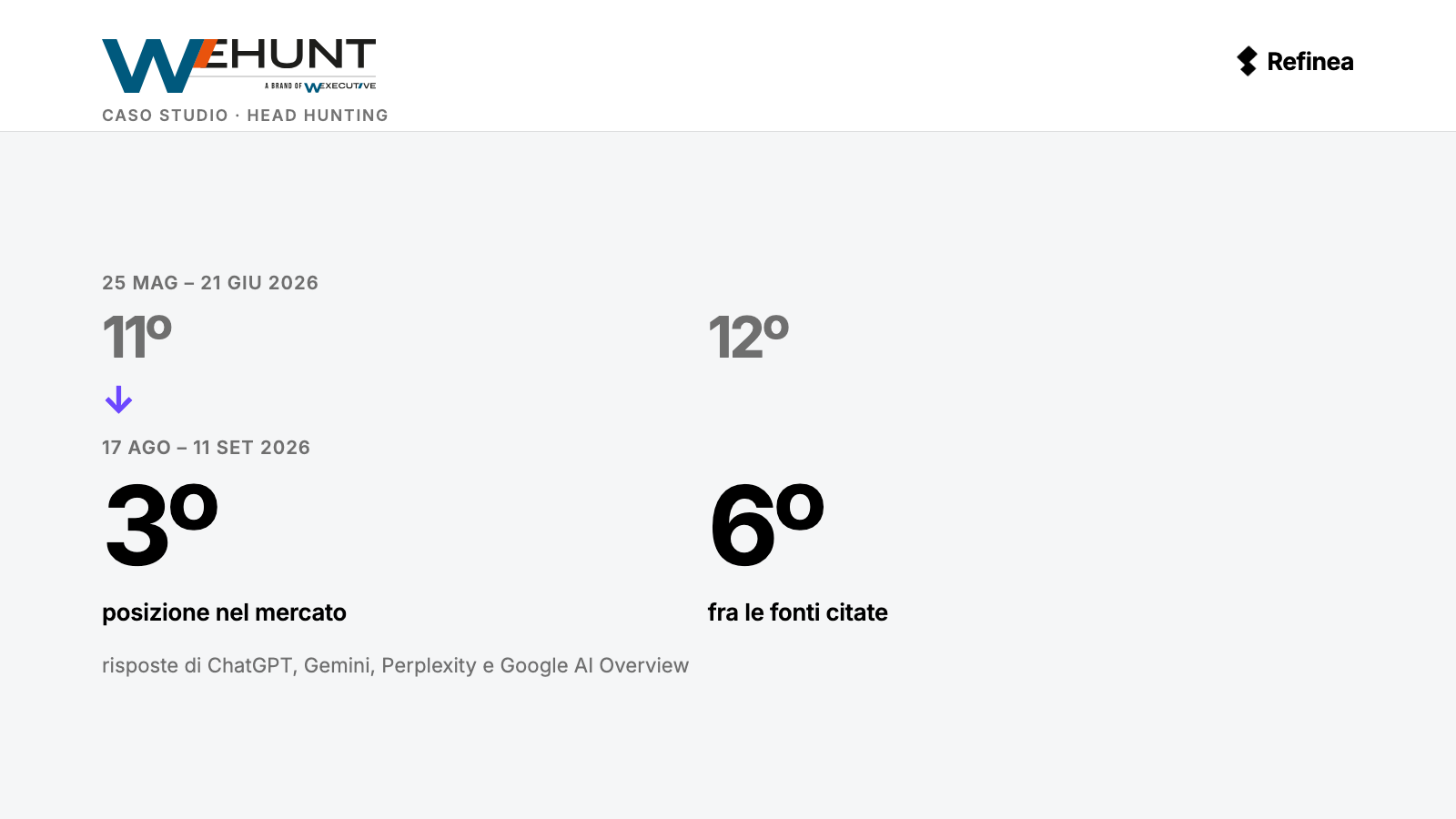
Michael Page, Robert Walters, Randstad, Spencer Stuart: these are the names that come up when someone asks an AI assistant how to find a head hunter in Italy. In three and a half months WeHunt went from eleventh to third among them.
- 11th → 3rd — among the brands assistants cite, from the first to the last month of tracking
- +121% — visits from AI assistants compared with the 108 days before the project started
- 12th → 6th — among the sources models consult to answer in this market
Where it started
WeHunt is the headhunting brand of W Executive. It works on middle and senior management profiles, against competitors named Michael Page, Korn Ferry, Egon Zehnder, Spencer Stuart: domains with decades of accumulated authority and communication budgets of another order of magnitude.
On 17 March 2026, in the last measurement before continuous tracking began, the picture was this: out of 2,954 brand mentions collected from assistant answers, WeHunt had four. Egon Zehnder had 246. Spencer Stuart 236.
The trajectory
Since 25 May 2026 the platform has asked four assistants — ChatGPT, Gemini, Perplexity and Google AI Overview — a hundred real market questions every day, and analysed the answers: who gets named, in what order, and which sources the model read in order to answer. Over 110 days that is 16,101 answers.
Tracking started together with the project, so for these metrics there is no earlier period to compare against: the comparison is between the first and the last month of tracking.
| Four weeks | Answers naming the brand | Position in the market |
|---|---|---|
| 25 May – 21 Jun 2026 | 23.1% | 11th of 507 brands |
| 22 Jun – 19 Jul 2026 | 22.0% | 11th of 690 |
| 20 Jul – 16 Aug 2026 | 25.5% | 5th of 697 |
| 17 Aug – 11 Sep 2026 | 27.5% | 3rd of 675 |
The jump is concentrated in the week of 3 August, when the share of answers naming the brand goes from 23% to 29%. Over the same stretch the site rises from twelfth to sixth among the sources models consult to answer about headhunting in Italy, and the share of citations it receives goes from 2.08% to 2.66%.
The mechanism: the space was taken from someone
The question that makes a result credible is not “did we grow”, but “did we grow because the engines cite everyone more, or because they cite us more”. Here the answer is measured by looking at who loses ground while the site gains it.
Between the first and the last month of tracking wehunt.eu moves from twelfth to sixth among the sources assistants consult when they answer about headhunting in Italy, and its share of citations rises from 2.08% to 2.66%. Over the same stretch several long-standing competitors in the sector — companies with far older and more authoritative domains — lose share among the cited sources. The total number of citations analysed in the period grows, but WeHunt grows much faster than the market it moves in.
The engines did not start citing everyone more. They moved space from someone towards them.
The same movement shows up outside the platform. Over the six months that cover the project, according to Ahrefs, the site went from just under fifty to 211 referring domains and from about a hundred to 618 backlinks: the kind of signal that precedes, and accompanies, a site entering the set of sources a model treats as reliable.
What they actually did
The work was done by the client, from their own account, over three weeks in July: citability audits on the key pages, rewritten headings, generated FAQs, internal links, an updated brand kit.
And two articles, built from the questions the market genuinely asks assistants. The first went out on 7 July and was cited by an assistant the next day. The second on 28 July, cited on the 30th. Together they account for over three hundred citations.
How content models cite gets made
Nobody invents the questions being tracked. They come from the client’s real Search Console queries, grouped by theme and rewritten the way people write to an assistant — which is not the way they write to Google. What gets measured is the demand that actually exists, not a list of plausible questions.
The content speaks like the brand. The articles are written from the brand voice the client uploaded to the platform: positioning, tone, phrases that belong to them. A piece models cite but that could belong to anyone does not build a brand.
The outline comes from query fan-out. When an assistant receives a question it does not search for that question: it breaks it into dozens of smaller searches, and builds the answer on those. Those searches are the query fan-out. Refinea records them at every measurement, and the agent that writes the articles uses them as structure: the section headings answer the questions the engine asks itself before answering.
Traffic
Here the comparison with the previous period can be made, because Google Analytics was collecting data beforehand. In the 108 days before the project started the site had received 56 visits from AI assistants; in the 108 that followed it received 124: +121%.
But the number that weighs most is another one: people arriving from ChatGPT stay on the site 174% longer than average, with 72.5% of visits generating engagement and more than eight interactions per session. In a sector where a single qualified application is worth thousands of euros, that traffic counts for far more than its volume.
How these numbers are measured
A hundred market questions, derived from the client’s Search Console data, asked every day to four AI assistants from 25 May to 11 September 2026: 16,101 answers analysed, 151,182 sources cited. “Answers naming the brand” is the share of answers in which the name appears. Position in the market compares the brand with every other name appearing in the same answers. A source’s share is the average of its shares across the individual engines, so a model that returns longer lists does not weigh more than the others. Traffic data comes from the client’s Google Analytics, extracted on 17 September 2026, and compares the 108 days of the project with the 108 immediately before.
When someone asks for a recommendation in your market, does your name come up?
Refinea measures every day how AI assistants answer in your sector, who gets named instead of you, and which pages models read to decide.