
In March 2026 the brand did not appear in any of the 755 answers analysed. Four months after the project started it is the third most cited name in its market.
- 3rd — among the brands assistants cite in its market, from a position of near-total absence
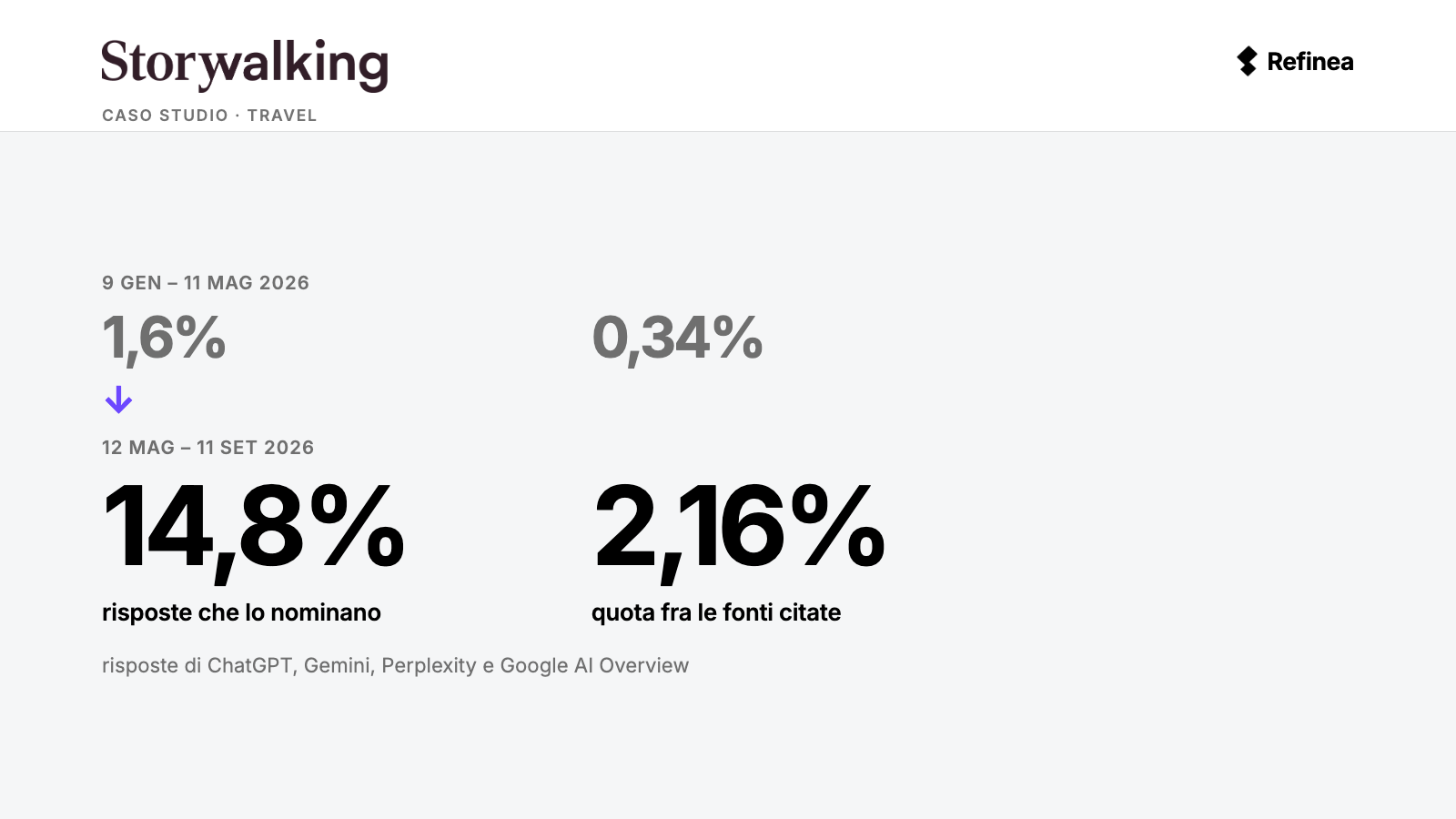
- 1.6% → 14.8% — assistant answers that name the brand
- 1 day — between publishing an article and its first citation
Where it started
Storywalking is an Italian tour operator that builds tailor-made cultural trips for an international audience. It competes with operators that have decades of history, in-house editorial teams and budgets a company this size cannot come close to.
In the 123 days before the project started the platform had already analysed 6,410 answers: the brand was named in 1.6% of cases, its site appeared in 0.34% of cited sources, and it did not even enter the top hundred names in its market ranking. To an AI assistant, in practice, it did not exist.
Why a comparison gets cited and a service page doesn’t
Storywalking stopped writing about its own offering and started publishing comparisons between operators: “the best companies for travelling in Italy”, “the best cultural immersion tours”. Put like that it is an old move, and anyone in this job has known it for twenty years. What changed is the reason it works.
An assistant that receives “who should I book a cultural trip in Italy with” does not search for that phrase. It breaks it into smaller searches, and several of those are already phrased as comparisons. A page that is itself a reasoned list of operators does not need to be interpreted: the names are already extracted, already ordered, already justified. It matches the shape of the answer, not just its subject.
The starting questions were not picked on instinct: they come from the ones tracking records in the market every day, and each article states which of them it has to answer.
The uncomfortable part is that a comparison like this also names the competitors, and names them on a domain that is yours. The risk is giving them visibility. The return is that the page becomes the source the model opens, and whoever wrote it is inside the list instead of outside the answer.
The article published on 2 July at 9:55 was cited by an AI assistant on 3 July. In the following weeks that page appeared in 12–16% of all Gemini answers in the market, and reached 288 citations.
The downside deserves saying too: the first page in the series, on its own, accounts for 54% of all the citations the site receives. It is a result and a concentration at the same time, because as long as that page holds, everything else holds. It is also why a series of pieces holds up better than a single one.
Before and after, over the same span
Four months of project against the four months immediately before: 123 days each, the same questions, the same engines.
| 9 Jan – 11 May 2026 | 12 May – 11 Sep 2026 | |
|---|---|---|
| Answers naming the brand | 1.6% | 14.8% |
| Share of voice in the market | 0.2% | 2.0% |
| Position among cited brands | outside the top hundred | 3rd of 1,054 |
| Share among cited sources | 0.34% | 2.16% |
| Citations received by the site | 69 | 2,298 |
And when it appears, it appears high up: the average position in the answers that name it is 4.0.
How content models cite gets made
The outline comes from query fan-out. When an assistant receives a question it does not search for that question: it breaks it into dozens of smaller searches, and builds the answer on those. Those searches are the query fan-out, and they are the closest thing there is to “what the model looks for while it answers”. Refinea records them at every measurement and the agent that writes the articles uses them as structure: the piece is not written on instinct and optimised afterwards, it is built from the start on the shape of the answer.
And it speaks like the brand. The article was written from the brand kit Storywalking uploaded to the platform — its positioning, its tone, its words. So the content models cite is recognisably theirs, and not a text interchangeable with any other operator’s.
How these numbers are measured
Real market questions in English, Spanish and Portuguese — the languages of the client’s audience — asked every day to four AI assistants: 6,410 answers analysed in the 123 days before the project started, 9,051 in the 123 that followed. “Answers naming the brand” is the share of answers in which the name appears; the ranking compares the brand with every other name appearing in the same answers; a source’s share is the average of its shares across the individual engines, so a model that returns longer lists does not weigh more than the others. Every comparison is between the project period and the immediately preceding period of equal length.
You don’t need to be the biggest. You need to be the one the model finds.
Refinea tells you which questions matter in your market, who gets named instead of you today, and which content changes the answer.